
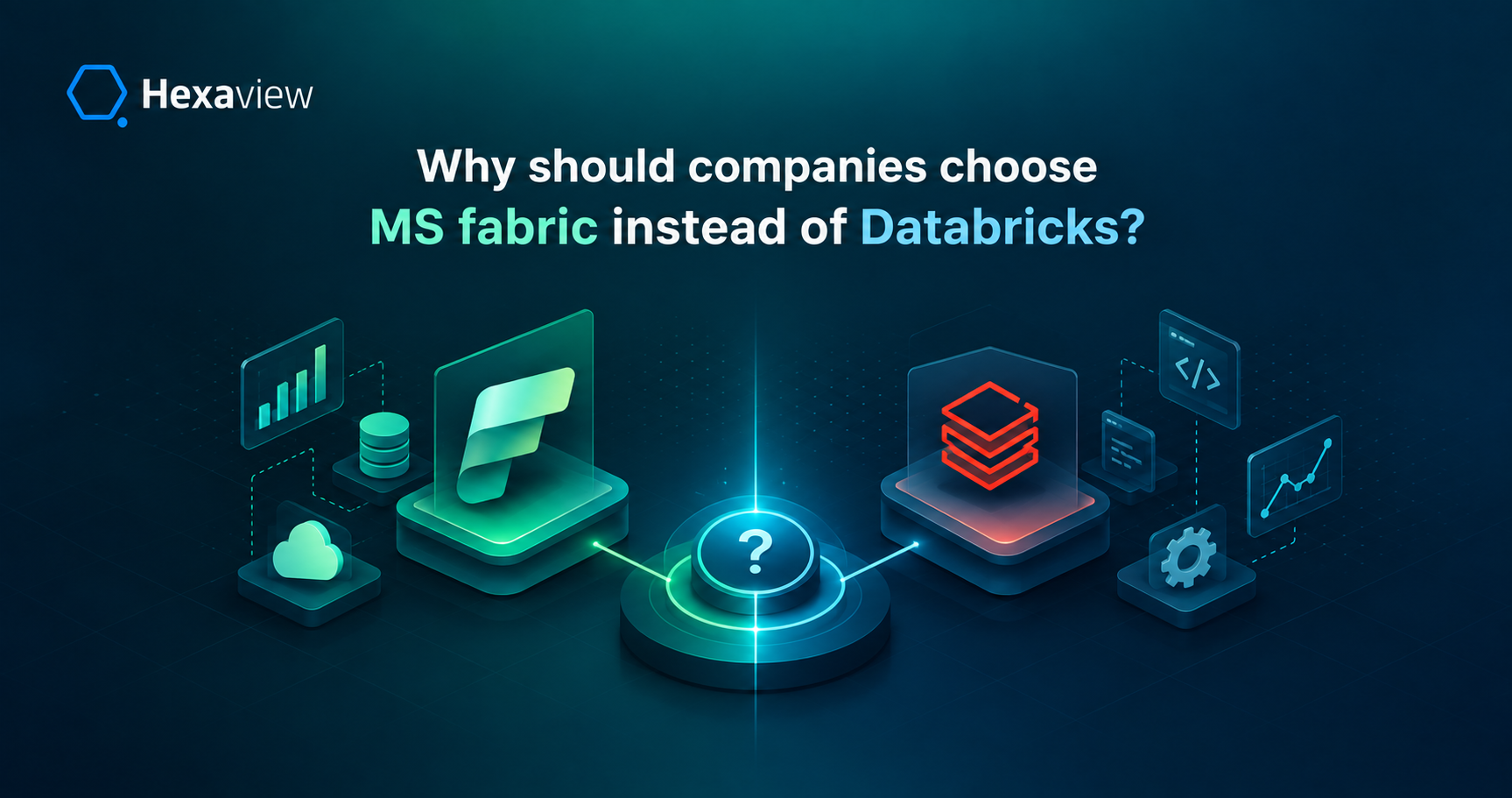
Companies that are looking for modern data platforms have started comparing Microsoft fabric and Databricks. It is crucial to fathom that both platforms support data engineering, lakehouse architecture, AI, and analytics. However, they optimize completely different enterprise priorities.
Therefore, the main question isn't simply which platform is more powerful. Decision makers must ask which solution creates the best fit. Organizations must evaluate their existing ecosystem, users, and overall Microsoft Fabric data platform operating model.
Unified Storage: Microsoft Fabric OneLake eliminates data silos by centralizing storage automatically across all workloads.
The fundamental distinction lies in operating simplicity rather than raw feature lists. Organizations must evaluate how many separate components their data engineers need to assemble.
Microsoft Fabric operates as a unified analytics SaaS platform. It combines data engineering, data integration, and enterprise warehousing in one location. Microsoft Fabric OneLake serves as the central data foundation for every organization. All Microsoft Fabric engines read from this shared storage directly without data copying. Power BI delivers native business intelligence experiences right out of the box. The entire Microsoft Fabric architecture connects technical teams and business analysts smoothly.
Databricks operates as a dedicated lakehouse platform for data and AI workloads. It relies on cloud object storage layered with open source Delta Lake technology. Teams query data through Databricks SQL while using external BI software for reporting. The environment offers unmatched power for technical data science teams.
Key Architectural Differences
Microsoft Fabric collapses traditional data architecture into a single SaaS platform. The system ingests data efficiently. It handles pipeline transformation smoothly. Engineers build lakehouses and enterprise warehouses within the same environment. Analysts create semantic models and report instantly through Microsoft Fabric Power BI. Integrated AI models complete the workspace seamlessly.
Companies heavily reduce the total number of platforms required to deliver insights. Engineers no longer stitch together disconnected tools for basic workflows. Microsoft unifies Dataflows, Spark pipelines, semantic models, and reporting natively. Organizations simplify operational management significantly through Microsoft Fabric analytics.
Microsoft Fabric OneLake acts as a single logical data lake for the enterprise. Every workspace accesses the exact same underlying storage layer directly. Built-in shortcuts connect external data repositories without expensive network transfers. Centralized security settings govern all access points uniformly.
The primary advantage involves managing data in fewer locations across the organization.
Microsoft Fabric Power BI integration offers an immense advantage to business users. Built in semantic models bridge raw data files directly into user dashboards. Direct Lake mode queries Delta tables in Microsoft Fabric OneLake instantly. This functionality skips slow data imports entirely while serving live enterprise reporting. Excel users consume identical semantic datasets directly from spreadsheets.
Teams seeking to build robust Fabric data engineering foundations can accelerate their business intelligence strategies rapidly. This seamless bridge keeps self-service analytics accurate across all corporate departments.
Adopting Microsoft Fabric extends existing technology investments logically. The platform connects naturally with Azure infrastructure, Microsoft 365 applications, and Excel spreadsheets. Microsoft Teams hosts live reports effortlessly across internal groups.
Entra ID secures the entire pipeline using established company permission policies. Teams apply current skill sets immediately rather than learning complex external frameworks. Microsoft Fabric consulting service providers help companies extend their tech stack cleanly without adding platform isolation.
Consolidating components simplifies technical operations across data engineering teams.
The Microsoft Fabric architecture reduces the total number of moving parts. A unified capacity model replaces separate billings across multiple vendors. This structure streamlines financial management and platform oversight substantially.
Fabric vs Databricks discussions often center on user collaboration. Technical personnel and business analysts work side-by-side inside Microsoft Fabric.

Engineers process data while analysts query output directly in the same workspace. This shared setup removes typical handoff delays between engineering and business units.
Evaluating Microsoft Fabric vs Databricks comparison metrics depends on current business goals. Organizations running established Power BI deployments benefit immediately from platform evolution.
Upgrading to the broader Microsoft Fabric data platform offers a natural upgrade path. It expands data capabilities directly from proven, everyday business tools.
Selecting Microsoft Fabric does not make Databricks technically inferior. Databricks remains the superior option when an organization prioritizes deep data science capabilities, complex machine learning operations, and massive Spark compute workloads. It excels at real time streaming pipelines, deep engineering customization, and open lakehouse frameworks. Teams with extensive Python, Scala, or Spark expertise often prefer its code first flexibility. Databricks also provides a multi cloud platform strategy across AWS, Azure, and Google Cloud.
Choosing Microsoft Fabric simply signals different business priorities. The decision favors tight SaaS integration, simple setup, and native Microsoft Fabric Power BI analytics over maximum customization.
Selecting the right platform comes down to aligning technology with business goals.
The best platform is not the one with the longest feature list. The optimal solution minimizes architectural complexity while supporting your actual workloads, users, and cloud strategy efficiently.
Selecting the right platform is only the first step. Executing a seamless transition requires specialized technical expertise. Hexaview Technologies operates as a premier Microsoft Fabric consulting service providers, guiding enterprises through complete architecture setup and data modernization.
Partnering with experienced Microsoft Fabric consulting service providers like Hexaview Technologies ensures zero-downtime migrations, robust data governance, and rapid ROI on your Microsoft Fabric data platform investment.
Microsoft Fabric is compelling when the goal is bringing data engineering, analytics, BI, and AI closer together. This advantage applies strongly to organizations already invested in Microsoft technologies.
Organizations evaluating implementation should also consider experienced Microsoft Fabric consulting service providers like Hexaview Technologies that can assess their existing architecture, workloads, governance requirements, and migration path before recommending a platform.
1. Can Microsoft Fabric Replace Databricks Entirely?
Microsoft Fabric can replace Databricks for organizations focusing primarily on business intelligence, standard warehousing, and reporting. However, Databricks remains necessary for complex machine learning models, custom Spark processing, and advanced data science pipelines.
2. Is Microsoft Fabric Built on Top of Databricks?
No, Microsoft Fabric is not built on Databricks. Microsoft Fabric is an independent SaaS platform developed directly by Microsoft. Both tools do support open Delta Lake storage formats natively, allowing smooth data sharing across platforms.
3. How Does Microsoft Fabric OneLake Differ from Databricks Storage?
Microsoft Fabric OneLake serves as a single SaaS storage foundation built automatically into every tenant. Databricks manage data across separate cloud object stores like AWS S3 or Azure ADLS Gen2 using Delta Lake tables.
4. Can Companies Use Microsoft Fabric and Databricks Together?
Yes, many enterprise organizations run a hybrid model successfully. Data engineering teams use Databricks for heavy machine learning and processing, while analytics teams query the results natively using Microsoft Fabric Power BI.
5. Which Platform Is Easier to Learn for Business Analysts?
Microsoft Fabric is significantly easier for business analysts to adopt. The SaaS interface combines familiar tools like Microsoft Fabric Power BI, Excel, and Dataflows without requiring complex infrastructure management.






.svg)



.svg)